Production Possibilities Curves and International Trade
Lecture 4
|
| |
Production Possibilities Curve (PPC)
|
1. Resources are used efficiently
- Resources
- Land
- Capital, i.e. machines and equipment
- Labor
- Entrepreneur
2. No technological progress
| A Production Possibilities Curve (PPC) |
| Food |
|

|
| Clothes |
3. Results
- Point X - indicates society is not using resources efficiently, e.g. recession
- Unemployment - not all workers are working
- Within the interior
- Point Y - beyond the resources for society to produce
- Point A - The U.S. produces 5 thousand units of food and 0 clothes
- How to get to Point B from Point A?
- Opportunity costs
- The U.S. wants to produce more clothes! The U.S. produces 1 thousand fewer units of food and gains 4 thousand more units of clothes
4. PPC is straight line if all resources are perfect substitutes
- Example: Land is input to farms and houses
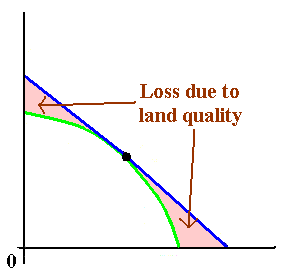
- Reality - land quality varies
| A PPC with Increasing Opportunity Costs |
| Food |
|
|
| Houses |
- Starting at the middle, as you go to any extreme, the opportunity cost increases
- Trade causes an industry to expand
- The opportunity costs increase
- Production has increasing cost as production expands
5. Curved PPCs have increasing opportunity costs
- The top graph is the PPC, while the bottom is the opportunity costs
- The opportunity cost is the slope of the PPC with the negative sign removed
| A Production Possibilities Curve (PPC) |
| Food |
|

|
| Clothes |
6. Economic growth - economy produces more goods and services over time
- PPC shifts outward
- Economy's resource base increases
- More labor
- Investment
- More machines
- More education (human capital)
- Technology progress
- "Improved legal structure" - Well-defined property rights
- Investment
- Asian tigers, China, and Japan have high savings level
- Deposits savings into banks
- Banks grant loans to businesses and households
- Households invest in houses, cars, etc.
- Businesses invest in buildings, machines, and equipment
- Requires a developed banking system
- PPC for U.S. and China
| The PPC for China |
The PPC for the United States |
| Machines |
Machines |
|

|

|
| Pizza |
Pizza |
6. Shifting the Production Possibilities Curve Inward
- War
- Natural disaster
- Poor legal system
|
Community Indifference Curves
|
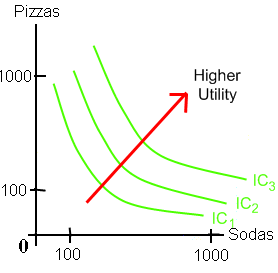
- Community indifference curves – indifference curve for the whole society
- Similar to the standard indifference curves for a consumer
- Goods have trade-offs
- Higher level indifference curves implies higher utility
| Community Indifference Curves |
|
|
- Problems
- People have different preferences; thus one cannot add up people’s indifference curves
- Problem defining national welfare
- Given a production level, will all citizens be satisfied at the production level?
- As the production level changes, some citizen’s utility may go up while other may go down
- Autarky
- Society produces and consumes at Point A
- Tangent line is relative price
- Price of laptops is too high. The slope is too steep.
| The PPC for a Country Engaging in Free Trade |
|

|
- Society produces and consumes at Point B
- Attain a higher community indifference curve
- Shift resources from laptops to wheat
- Costs decrease for laptop industry
- Price falls for laptops
- Cost increase for wheat industry
- Price increases for wheat
|
Free Trade
|
- Free trade
- Factor mobility – movement of labor, resources, land, etc.
- As country opens up to free trade, factors move from import industry to export industry
- Export industry has comparative advantage
- China has comparative advantage in laptops
- U.S. has comparative advantage in wheat
- Tangent line is relative prices in laptops per wheat
- i.e. this is price of wheat
- U.S. has low wheat price, while China has high wheat price
| The PPCs for China and the U.S. Engaging in Free Trade |
|

|
- Both countries move to a higher community indifference curve
- As industry expands, opportunity cost increases
- A country cannot lose an entire industry
- Relative prices are the same for both countries
- Exports = imports for both countries
|
The Heckscher-Ohlin Theory
|
- The Heckscher-Ohlin Theory – a country exports products that uses abundant factor resources and imports products that use scarce factor resources
- Labor
- Labor abundant – a country has a higher ratio of labor to other factors relative to the world
- Labor intensive – if labor costs are a larger share than the other factor costs
- Could apply to land and capital
- Technology may play a role; countries with advanced technology exports high-tech goods
- Example 1
- U.S. has abundant farming land and scarce labor
- Thus, the U.S. exports agricultural products and imports labor intensive products
- Example 2
- China has little land, many people
- China has 20% of the world's population, but only 10% of the world's farming land
- China is moving away from agricultural production to labor-intensive production
- China exports manufactured products, and imports agricultural products
- Jiangsu has fertile farm land, but makes textiles, steel, and industrial products
|