An Introduction to Tourism Economics
Lecture 1
|
| |
What is Tourism Economics?
|
|
1.
Tourism economics
has the following components
-
Leisure
- time remaining after work, commuting, house chores, sleeping, etc.
-
Recreation
- activities during leisure time
- Reading a book
- Sports
- Tourism
-
Tourism
- visiting for at least one night for leisure and holiday
- Visiting a place outside the normal home and work environment
-
Tourist organizations
- produce goods and services used in leisure time
2. People's wants are unlimited and exceed resources to satisfy these wants

|
People make choices because goods and services are scarce.
Economics
- choices that arise from scarcity
|
3.
Opportunity cost
- the highest valued alternative that must be sacrificed in choosing a good.
- Ensures we use resources for the best uses
- Are subjective, because a good's value is subjective; individual's preferences matter!
- Includes the value of time.
- The value of purchasing power spent.
- Examples:
- A couple chooses Paris over Rome. Rome is the opportunity costs.
- College education - a student attends college as opposed to work
- Note - even though going to college is expensive, students expect to recoup these costs from higher lifetime incomes.
| Example: The opportunity cost of college: |
| Opport. cost |
Tuition, books, room, & board |
$10,000 per year |
| Opport. cost |
Not working (forgone earnings) |
$20,000 per year |
| |
Total
|
$30,000
|
4. Allocative mechanism - a society uses a means to allocate resources
- Free market economy
- Private ownership of firms and resources
- Profits motivate firms
- Firms only supply profitable activities
- Price and quantity are determined by interaction of consumers (demand) and producers (supply)
- Centrally planned economy
- Government owns all firms and resources
- A central committee determines prices, quantities, and production
- Usually shortages and surpluses
- Consumers have more limited choices and stand in long lines for products and services
- Mixed economy
- Mix of both systems
- Government owns property and resources in some industries and allows private enterprise in others
- Examples - China and Cuba
- All countries - government uses taxes, subsidies, regulations, and spending power to control a society
5. Analysis
-
Macroeconomics
- study the whole economy of a country in broad sectors
- Macro means “large” or “aggregates”
-
Aggregate
- combine together many units
- Four sectors: Government, households, businesses, and international
- Examples:
- Inflation
- Unemployment
- Government debt
- Total consumer expenditures
- Trade deficit
-
Microeconomics
- study specific economic units
- Micro means “small”
- Examples:
- An individual
- A firm
- A market
- We will use both in this class
-
Ceteris paribus
- Latin term
- "other things constant"
- Q d = f(P Coca-cola, P Pepsi, Income, Tastes/preferences, etc.)
- Q d: Quantity demanded of coca-cola.
- P Coca-cola: Price of coca-cola.
- P Pepsi: Price of Pepsi.
- How does the quantity of Coca-Cola change, if consumer income changes? Other things must be held constant. Then exact relationship can be determined.
- In reality all other factors do change, so it is difficult to determine exact relationships.
- Economics is a social science!
- Not like physics or chemistry, where one variable can be changed at a time in a laboratory
6. Cost-Benefits Analysis
- As the benefits increase for choosing a product, a person more likely chooses that product
- As the costs increase for choosing a product, a person less likely chooses that product
- Example: "Law of Demand"
- As the price of computers
 , consumers buy , consumers buy 
7. Economic analysis are based on
marginal
costs and
marginal
benefits
-
marginal
- "change in number of units,"
- "additional units,"
- "extra units"
- Marginal refers to slope of demand and supply curves
- Example:
|
Bank Account
|
Balance
|
Change / Marginal
|
| Deposited $100 |
$100 |
+ $100 |
| Bought pizza for $10 |
$90 |
- $10 |
| Cash gift of $50 |
$140 |
+ $50 |
|
Characteristics of Tourism
|
|
1. Types of Tourism
- Leisure Tourism - relax and explore a new place
- Business Tourism - tourist explores new places for business activities or establish new contacts
- Health Tourism - tourist travels for health reasons
- Medical operations and surgery
- U.S. has many restrictions and regulations, so tourists go to India, Malaysia, etc. for medical operations
- Experimental surgeries and operations
- Surgeries and operations may also be cheaper
- Visit a health spa or resort
- Winter Tourism - tourists travel during winter time
- Spend a weekend skiing, sledding, etc.
- Escapes the cold winters and travel to tropical destinations
- Education Tourism - tourist attends a conference, temporary training, etc.
- "Sin" Tourism - tourists engage in activities that may be illegal or immoral at their normal residences
- Tourists may participate in activities that they would never do at their normal residence
- Gambling
- Illegal products and services
- Hundreds of categories
2. Top Tourist Destinations
| 2010 Rank |
Country |
2010 Number of Tourists |
| 1 |
France |
76.80 million |
| 2 |
United States |
59.75 million |
| 3 |
China |
55.67 million |
| 4 |
Spain |
52.68 million |
| 5 |
Italy |
46.63 million |
| 6 |
United Kingdom |
28.13 million |
| 7 |
Turkey |
27.00 million |
| 8 |
Germany |
26.88 million |
| 9 |
Malaysia |
24.58 million |
| 10 |
Mexico |
22.40 million |
| Country |
2010 Tourist Spent |
Spending per tourist |
| United States |
$110.1 billion |
$1,843 |
| Spain |
$61.6 billion |
$1,169 |
| France |
$55.6 billion |
$724 |
| Italy |
$45.7 billion |
$980 |
| China |
$40.8 billion |
$733 |
| Germany |
$40.0 billion |
$1,488 |
| United Kingdom |
$36.0 billion |
$1,280 |
| Australia |
$24.7 billion |
$4,194 |
| Turkey |
$22.0 billion |
$814 |
| Austria |
$21.8 billion |
$991 |
Assumptions
- Does the tourist spending include airfare?
- How were the different currencies converted to U.S. dollars?
- How accurate are the numbers?
- How does a gov. official distinguish between a local and tourist spending?
- Are tourists accurately counted?
- Airports is easy
- Land borders are more difficult
3.
Multiplier Effect
– increase of $1 of spending by tourists boost incomes by more than $1
- Tourists spent $18.5 million at hotels, airlines, restaurants, cafes, etc.
- These businesses earn more profits and hire more workers
- More workers earn salaries that they spend at stores, cars, houses, etc.
- Businesses for houses, cars, and stores earn more profits and hire more workers
- Thus, $1 of tourist spending leads to more than a dollar of generated income
- Example
- Assume the tourist multiplier is 2
- If tourists spend $18.9 billion in Malaysia, then the multiplier effect leads to $37.7 billion creation of incomes in the Malaysian economy
|
Advantages and Disadvantages of Tourism
|
|
1. Advantages
- Economic
- Increases GDP
- Increases incomes
- Provides employment opportunities
- Generates foreign exchange
- Expand existing infrastructure
- Help stimulate local commerce and industry
- Can be developed with local products and resources
- Diversifies the economy
- Tends to be compatible with other economic activities
- Spreads development
- High multiplier impact
- Increases governmental revenues
- Social
- Broadens educational and cultural horizons
- Improves quality of life - higher incomes and improved standards of living
- Justifies environmental protection and improvement
- Local population can use the tourist and recreational facilities
- Cultural
- Preserve heritage and tradition
- Creates local interests in artists, musicians and other performing artists
- Breaks down language barriers, sociocultural barriers, class barriers, racial barriers, political barriers, and religious barriers
- Creates a favorable worldwide image for a destination
- Promotes a global community
- Promotes international understanding and peace
2. Disadvantages
- Economic
- Develops excess demand
- Results in high leakage
-
Leakage
– an outflow flow of income from the economy (savings, taxes, and imports)
- Examples
- Gov. loses potential tax revenue by passing tax exemptions
- Gov. spends funding for tourism advertising
- Creates difficulties of seasonality
- Causes inflation
- Can result in unbalanced economic development
- Increases vulnerability to economic and political changes
- Social
- Creates social problems
- Degrades the natural physical environment and creates pollution
- Degrades the cultural environment
- Threatens family structure
- Commercializes culture, religion, and the arts
- Creates misunderstanding
- Creates conflicts in the host society
- Contributes to disease, economic fluctuation, and transportation problems
|
Production Possibilities Curve (PPC)
|
-
Production Possibilities Curve (PPC)
- shows how much goods and services can be produced for society given its limited resources.
- Macroeconomics example
- Only two products are produced in this society
- Resources are used efficiently
-
Resources
- Land
- Capital, i.e. machines and equipment
- Labor
-
Entrepreneur
- a person who seeks profits by introducing new products or lowering production costs.
- Bill Gates, Sam Watton, etc.
- No technological progress
| PPC for U.S. |
Milk
(in thousands)
|

|
| |
Hotels
(in thousands)
|
-
Point X
- indicates society is not using resources efficiently, e.g. recession.
- Unemployment - not all workers are working
- Within the interior
-
Point Y
- beyond the resources for society to produce
-
Point A
- The U.S. produces 5 (thousand) milk and 0 hotels
-
How to get to Point B from Point A?
- The U.S. wants to produce more hotels! The U.S. produces 1 (thousand) less bottles of milk and 4 (thousand) more loaves of bread
- Opportunity costs of moving from Pt A to Pt B
- Had to switch resources from milk to hotel production.
|
|
All points, A, B, and C are efficient; need more information to determine which point. |
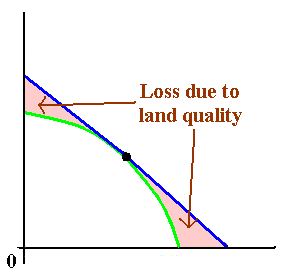
- PPC is straight line if all resources are perfect substitutes.
- Example: Land is input to farms and hotels
- Reality - land quality varies
- As we approach an extreme of all farms or all hotels, then losses occur because of land quality.
- Some land is better suited for farms while other land is more suitable for hotels.
| PPC for U.S. |
| Farms |
|
| |
Houses
|
|
|
The shape of the PPC - some resources are better suited for the production of one good, while other resources are better suited for producing the other good. |
2. Shifting the Production Possibilities Curve Outward
-
Economic growth
- economy produces more goods and services over time
- Economy's resource base increases
- More labor
-
Investment:
- More machines
- More education (human capital)
- Technology progress
-
Invention / Innovation
- creation of a new product or process
- Entrepreneur creates new products
- "Improved legal structure"
- Well-defined property rights
- Laws that allow corporations to form - allows mass production
- Work harder and give up leisure time
3. Shifting the Production Possibilities Curve Inward
- War
- Natural disaster
- Poor legal structure
4. Economic growth from investment
- In Year 2008, both China and U.S. have same PPC
- China produces more machines at
Point A
, while U.S. produces more bread at
Point C
- In Year 2009, both economies grow, because they have more machines (i.e. capital). PPC curves shift outward.
- However, China produces more machines, therefore its PPC shifts more than the U.S.' s PPC.
| China |
U.S. |
| Machines |
Machines |

|

|
| Bread |
Bread |
|
Terminology
|
- tourism economics
- leisure
- recreation
- tourism
- tourist organizations
- economics
- opportunity cost
- macroeconomics
- aggregate
- microeconomics
|
- ceteris paribus
- marginal
- multiplier effect
- leakage
- production possibilities curve
- resources
- entrepreneur
- economic growth
- investment
- invention / innovation
|
|