Review - Supply and Demand
Lecture 2
|
|
|
Demand - The Consumers
|
|
1.
Marshallian Demand Schedule
- shows the quantity and price of a good, which consumers are willing to buy, ceteris paribus.
- Note - demand has a time unit!
-
Marshallian Demand Curve
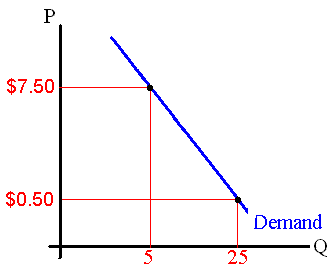
is a graph of the demand schedule
| Buyer's demand for restraurants (per year) |
Price
($ per meal) |
Quantity demanded
(number of meals per week) |
| $7.50 |
5 |
| $5.00 |
10 |
| $2.50 |
15 |
| $1.00 |
20 |
| $0.50 |
25 |
|
Buyers' Demand Curve
|
| Price |
|
| Quantity |
-
Law of Demand
- as the market price increases, the quantity demanded for a good decreases, ceteris paribus.
- The slope of the line is negative
- Note - demand for a Giffin good has a positive slope
- Why?
- Common sense
- When products are expensive, people buy less
- The principle behind business discounts
-
Law of Diminishing Marginal Utility
- consuming additional units of a good yield less and less additional utility i.e. satisfaction.
- Example: Hypothetical case for pizza
- utils are fictional units for satisfaction
-
1st slice, a person receives 100 utils (lots of satisfaction), so he values it at $5 per slice.
-
2nd slice, a person receives 20 utils (some gain in utility), so he values it at $3 per slice.
-
3rd slice, a person receives 5 utils (very little gain in utility), so he values it at $1 per slice.
- Total utility = 125 utils; total spent = $9 for 3 slices of pizza
- Composed of two effects.
-
Income Effect
- as a product's price decreases, a constant income buys more
- Example: Monthly income is $1,000 and price of beef decreased
- Income effect - you can buy more beef with fixed income
-
Substitution Effect
- as price of a product decreases, people start buying it and “substitute away” from more expensive, similar goods.
- Example: As the price decreases for Coca-Cola relative to Pepsi, people substitute Coke for Pepsi
- Price change affects consumer's behavior
- Income effect plays an important role in the three welfare measures
- Marshallian demand function (measurable)
- Hicksian demand function (theoretical)
2. Market Demand Function
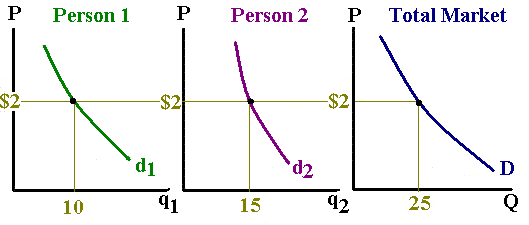
- Two people are in the market.
- Each person has their demand function.
- The quantity denoted by q is for a person, while Q is the total market quantity.
- Likewise, demand by a consumer is denoted by d, while market demand is D.
- Market demand - at each market price, horizontally sum the quantity that each consumer buys.
|
Changes in Demand Versus Changes in Quantity Demanded
|
|
1.
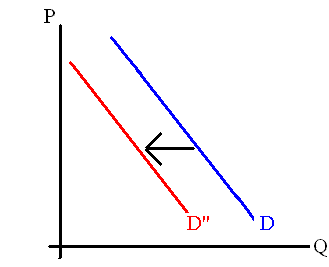
"Change in Demand"
- the demand curve shifts. Shift curves only "left" or "right." Do not think of shifting curves "up" or "down."
|
Demand decreases
|
Demand increases
|
|

|
"Change in Quantity Demanded"
- movement along the same demand curve, because the price changed.
|
Movement along Demand Curve
|

|
2. Shifting the demand curve to the right; demand increases
-
Disposble income
- consumer income remaining after paying payroll taxes
-
Normal good
- as income increases, people have more money, and buy more, ceteris paribus
- Majority of goods, including tourism
-
Inferior good
- as income decreases, people have less money and buy more inferior goods, ceteris paribus
- Number of consumers increases
- More people in the market to buy goods, ceteris paribus
- Price of other goods
-
Substitute good
- price increases
- The price of DVD's increases, therefore, the demand increases for VCR tapes, ceteris paribus
-
Complement good
- price decreases
- The price of DVD's decreases, therefore, the demand for DVD players increases, ceteris paribus
-
Expectations
- consumer expectations of future prices, future availability, or future income.
- During 1999 people believed widespread water shortages would occur from Y2K. Thus, demand for water increased during 1999, ceteris paribus.
-
Tastes and preferences
- for example, a report stated coffee reduced colon cancer, demand for coffee increases, ceteris paribus.
- Fashion - some places like Greece and Florida fall in and out of vogue
- Advertising - can have a big impact; The Learning Channel (TLC) has numerous travel shows
- Quality - differences in restruarants, hotels, vacation packages, etc.
-
Weather
- if the summer is very hot, then people drink more Pepsi, ceteris paribus
- Opportunity for leisure

|
If the opposite occurs, then the demand curves will shift left, i.e. decrease. |
|
Supply - The Producers
|
|
1.
Supply schedule
- shows the quantity and price of a good that firms are willing to produce/sell, ceteris paribus.
-
Supply curve
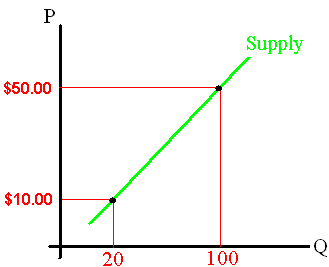
- a graph of the supply schedule
-
Law of Supply
- as the good's price increases, then quality supplied increases, ceteris paribus.
- Why?
- As the price increases, the producers receive more revenue.
- Note - as production increases, then production costs may increase. The higher price off-sets the additional production costs.
- Note - the supply schedule has a time unit
| Supply of Hotel Rooms (per week) |
Price
($ per room) |
Quantity Supplied
(number of rooms) |
| $50 |
100 |
| $40 |
80 |
| $30 |
60 |
| $20 |
40 |
| $10 |
20 |
|
Supply Curve
|
| Price |
|
| Quantity |
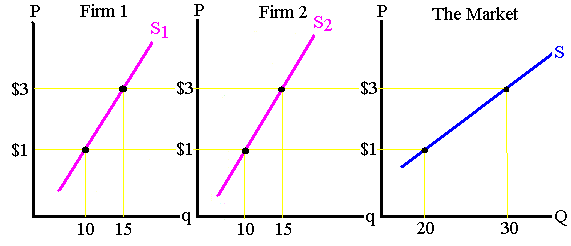
2. The short-run market supply is the horizontal sum of the all firms' short-run supply curves. (Just like the demand curve). Market supply is derived from two firms below:
|
Changes in Supply Versus Changes in Quantity Supplied
|
|
1.
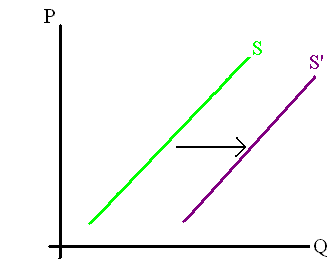
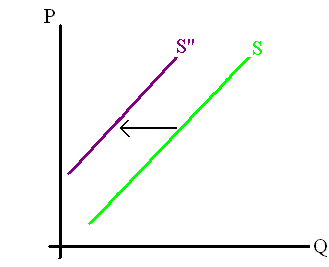
"Change in Supply"
- entire supply curve shifts.
- Shift curves only "left" or "right."
- Do not think of shifting curves "up" or "down."
|
Supply increases
|
Supply decreases
|
|
|
"Change in Quantity Supplied"
- movement along the same supply curve in response to a price change.
|
Movement along Supply Curve
|

|
2. Shifting the supply curve to the right; supply increases.
- Resource prices
- Labor wages or resource materials' price decreases, firms can supply more because of lower production costs
- Technological advances
- Technology allows firms to produce more output, using the same levels of resources
- Nature and political disruptions
- Favorable weather for growing crops, resolving wars, etc.
- Decrease in taxes or increase government subsidies
- Decrease business cost and firms can provide more at each price
- Price of other goods
- Price for corn increases, so non-corn farmers start growing corn
- Producer's expectations of future prices.
- Firms expect sugar prices to be higher next year. Some firms hoard sugar now, and sell the supply of sugar for next year
- Number of sellers
- More sellers in the market means more is produced
|
|
If the opposite occurs, then the supply curves will shift left, i.e. decrease. |
|
How Market Prices Are Determined
|
-
Market
- an institution that brings buyers and sellers together for specific goods and services.
- Examples:
- New York Stock Exchange - market for buyers and sellers of stock for well-known corporations
- Foreign currency market
- Commodity market
- Assumption:
- The markets are perfectly competitive, i.e. large number of independent buyers and sellers
- No government intervention
- Perfect knowledge of prices
-
Equilibrium
- a state of rest; market price and quantity do not change
-
Equilibrium price
- market price where the forces of supply and demand are equal
-
Equilibrium quantity
- market quantity where the forces of supply and demand are equal
|
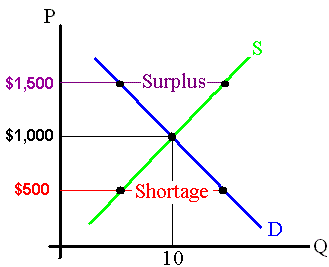
The Market for Cruise Vacation
|
|
-
At $1,000
, quantity supplied = quantity demanded:
- Equilibrium price = $1,000
- Equilibrium quantity = 10 (thousand) units
-
At $1,500
, quantity supplied > quantity demanded:
- Surplus
- Suppliers have to much product, so price falls until it equals $1,000
-
At $500
, quantity supplied < quantity demanded:
- Shortage
- Consumers demand more than what is in stock, so they bid prices up until it equals $1,000
|
How Markets Respond to Changes in Supply and Demand
|
|
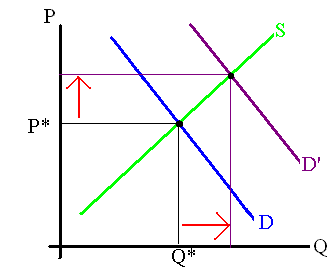
Example 1
- Market - Vacation in Cancun
- Travel agents increase the price for vacation packages for Los Cabos
- Substitutes- Los Cabos is located in western Mexico, while Cancun is in eastern Mexico
- Demand for Cancun vacation packages increases (shifts right)
- Travelers vacation more in Cancun
- Equilibrium price and quantity increase
|
|
Vacation in Cancun
|
|
|
|
Example 2
- Violence and protests erupt in Egypt
- Tastes and Preferences - travellers are concerned for their safety
- Demand decreases (shifts left)
- Less travellers vacation in Egypt
- Equilibrium price and quantity decrease
|
|
Vacation in Egypt
|

|
|
|
Example 3
- Peace and political stability returns to Egypt
- Business climate becomes favorable to businesses again
- Supply increase (shifts right)
- Equilibrium price decreases
- Quantity increases
|
|
Vacation in Egypt
|

|
|
|
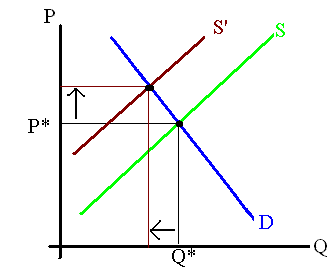
Example 4
- Thailand increases a tax on all hotels and restraurants
- Hotels and restraurants increase their prices
- Supply decreases (shifts left)
- Business cost increase
- Equilibrium price increases
- Quantity decreases
|
|
Vacation in Thailand
|
|
|
|
Economics of Price Controls
|
|
Price controls
- government mandated prices. Government thinks price is too high or too low.
1.
Price ceilings
- a legally established maximum price that sellers may charge.
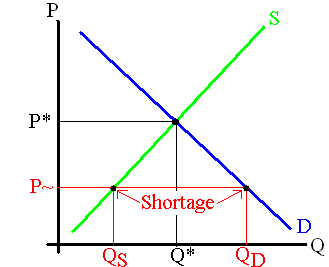
- Government thinks rent is too expensive. The market price is P*, but the government sets maximum price at
P~
.
- Rent control price < market rent:
- Direct effect (When P* >
P~
).
- Quantity demanded (
Qd
) > quantity supplied (
Qs
).
-
Shortage
- Shortage does not disappear, because of the price control
| Rental Market |
| Price, Rent |
|
| Quantity, Tenants |
- Secondary effects of price ceilings.
- Long waiting lists
- "Under the table" payments to landlord
- Buying expensive furniture from landlord.
- The lower price (i.e. rent) causes investors to avoid investing in new housing.
- The quality of housing will deteriorate.
- Less maintenance and repairs, which lower costs.
|
|
If
P~
> P*, then the price control has no effect on the market. |
2.
Price Floor
- a legally established minimum price that buyers must pay.
- Government thinks workers' wages are too low and set the minimum wage rate to $5.30 per hour (
P~
).
- Employers demand workers, while employees supply labor.
- Direct effect (When
P~
> P*).
- Quantity supplied (
Qs
) > quantity demanded (
Qd
).
-
Surplus
- i.e. unemployment in this case
| Labor Market (Unskilled workers) |
| Price |

|
| Quantity |
- Secondary effects of price ceilings.
- Employers reduce the following benefits.
- Health insurance.
- Job training.
- Pension plans.
- Minimum wage usually hurts unskilled labor, the poor, and teenagers.
|
|
If P* >
P~
, then the price control has no effect on the market, such as professional jobs which pay more than $5.30 per hour. |
|
Black Markets
|
-
Black Market
- markets that operate outside the legal system
- Also called the hidden economy or underground economy
- Illegal products and services
- Avoid high taxes
- Avoid costly regulations
- Circumvent price controls
- Decline in civic loyalty to government
- Black markets have:
- More defective products
- Higher profits
- Higher risk:
- Arrests
- Court fines and fees
- Jail or prison sentence
- Greater violence from enforcing contracts
|
Terminology
|
- Marshallian demand schedule
- Marshallian demand curve
- law of demand
- diminishing marginal utility
- income effect
- substitution effect
- normal goods
- inferior goods
- substitute good
- complement good
- change in demand
- change in quantity demanded
- opportunity cost of production
- supply schedule
|
- law of supply
- supply curve
- change in supply
- change in quantity supplied
- market
- equilbrium
- equilibrium price
- equilibrium quantity
- price ceiling
- shortage
- price floor
- surplus
- black markets
|
|