Macroeconomics and Tourism
Lecture 6
|
| |
The Keynesian Multiplier Effect
|
|
1.
Keynesian Multiplier Effect
- the impact on the economy (or GDP) when spending or investment changes in the economy
- Example - Hilton builds a new resort-hotel on Langkawi
-
Direct Effect
- Hilton invested $50 million in building the facility
- Hilton hires 200 workers
- Construction hires 500 workers (temporary)
-
Indirect Effect
- with more income, the employees and construction workers spend more
- New houses
- New cars
- Clothing, restaurants, cinemas, etc.
-
Induced Effect
- local businesses have more customers and earn more profits and income
- These businesses hire more workers
- Workers work longer
- These employees have higher income and increase their spending and savings
- The process continues indefinitely
- The $50 million investment in Langkawi could result in more than $50 million in incomes
- Other benefits
- More local labor is hired
- More income generates more government's tax revenue
- Government can increase its spending and provide more services to the community
- The more money changes hands, the higher the income
- Note - a tourist who bring foreign currency, will have the same impact
2. The multipler effect can also apply to a contraction
- Economists do not focus on this
- Example - a large firm or plant shuts down
- Workers are laid off
- They have less income and decrease their spending and savings
- Other businesses experience a slow down
- They reduce their workforce
- The process continues indefinitely
- Note
- Less income means government collects less tax revenue
- Usually government increases or expands taxes
- Example
- Flint, MI - GM shut down its factories
- Gary, IN - U.S. steel industry severely contracted with competition from Japan during 1980s
- Problems
- Jobs left, then the workers with money left
- The poor were left behind, and crime and drugs became rampant
3. The ratio method to derive the multiplier
- What drives the multiplier?
- Investment
- Changes in government spending,and taxes
- Changes in net exports
- Tourists' spending
- Example: Investment increases by $100
- MPC = 0.9 and MPS = 0.1
- Round 1: Income increases by $100; Savings is $10 and consumption is $90
- Round 2: Income increases by $90 Savings is $9 and consumption is $81
- Round 3: Income increases by $81 Savings is $8.10 and consumption is $72.90
- Infinity Total savings is $100 and total consumption is $1,000
- This is an infinite sequence
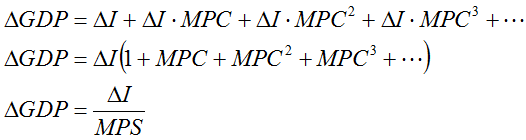
- For our example, GDP changes by

- Note - Savers deposit their money into banks
- The banks grant loans to businesses for new investment
- If people hide their money in a mattress, then banks do not have money to lend out for new investment
- Banks and investment go hand in hand with economic development
- We can also calculate the multiplier in two ways
- First way we know MPS (or MPC), then the multiplier is:

- Second, if we knew how GDP changed when investment changed, then we use algebra to rearrange the equation to get:

|
Deriving the Multiplier
|
|
1. Definitions
-
Disposable Income (DI)
- remaining income after taxes are deducted
- Disposable income is either spent on consumption or saved
-
Marginal Propensity to Consume (MPC)
- the amount a society increases its consumption, if its aggregate disposable income increases by $1
- Marginal is important!
- Example, a low-income country has a GDP per capita of $5,000 per year
- People may have low savings rate
- People may have high consumption rate, because of food
- Banking system may not develop well with low savings rate
- Example, a high-income country like Qatar has a GDP per capita of $80,000 per year
- People have high savings rates
- Qatar can invest its money in developed countries like Europe and United States
- Savings and consumption can be different for different levels of disposable income
- MPC is the slope of the consumption function, C = f(DI)

-
Marginal Propensity to Save (MPS)
- the amount a society increases its savings, if its aggregate disposable income increases by $1
- MPS is the slope of the savings function, S = g(DI)
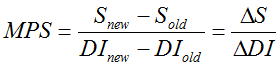
- By definition, MPS + MPC = 1, because if disposable income increases, a society either spends it or saves it.
- As disposable income increases, both the consumption and savings increase
- Both C = f(DI), and S = g(dI) have positive slopes
2. Factors shift the consumption and savings functions
- Wealth - households' level of wealth determines consumption and savings
- As households become wealthier, their consumption may increase
- physical - houses, cars, real estate, and land
- financial - cash, stocks, bonds, pensions, etc.
- Example - Financial crisis of 2008
- Stock prices and home values are dropping, people become less wealthy and may decrease their consumption
- Both consumption and savings functions decrease and shift downward.
- Expectations - households expectations of the future determine consumption and savings levels
- Example - A person graduated from college and found a high-paying job, his consumption and savings will both increase
- 2008 Financial Crisis
- With an uncertain financial future, households will save more
- Consumption function could decrease and savings function could increase
- Real Interest Rates - impact household consumption and savings
- If real interest rates are low, households decrease their savings, and increase their consumption
- Household Debt - households can borrow from future income
- Households can consume more today by borrowing and increasing their debt
- Consumption increases, while savings functions both could decrease
- Taxes
- If government increases taxes, disposable income decreases
- Households have to lower their consumption and/or savings
- Consumption and savings functions both could decrease
3.
Aggregate Expenditures (AE)
- the total spending by all sectors in an economy
- Consumption
-
Autonomous Spending (A)
- the y-intercept
- Spending is independent of income (i.e. GDP)
- Consumers still need a level of spending with no income
- MPC - the slope of the line
- Give consumers $1 more dollar in income, MPC is the amount that goes to spending

- A graph of the consumption is below:

-
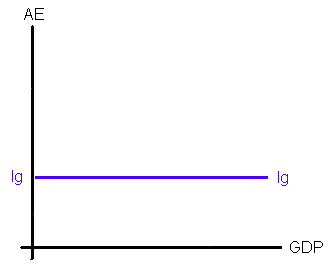
Gross investment (Ig)
- all investment in society
- assume investment is independent of GDP and Aggregate Expenditures
-
Net exports (Xn)
= Exports (X) - Imports (M)
- If Xn > 0, country exports more than what it imports
- Expands domestic production
- Has multiplier effect
- If Xn < 0, country imports more that what it exports
- Expands production for foreign country
- Negative multiplier effect
- The foreign country gets the multiplier effect
- Shifting level of net exports
-
Government spending (G)
- Independent of GDP
- Government finances spending through taxes
-
Lump sum taxes
- taxes are assessed as a fixed dollar amount
4. Equilibrium
- Equilibrium is when, Aggregate Expenditures (AE) = GDP
- AE is one definition of GDP
- This is the 45 0line
-
Leakages
- withdrawals from income / expenditure stream
-
Injections
- income is injected into income / expenditure stream
- Investment
- Government spending
- Exports
- Equilibrium
- AE = GDP and AE = C + Ig + G +Xn
- Leakages = Injection
s
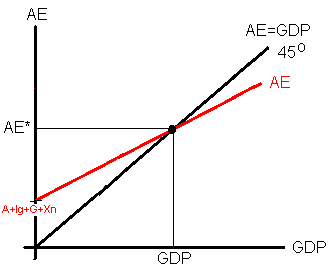
5. Derive the multiplier by substituting the consumption function and equilibrium condition into the AE. Then use algebra to solve for the equilibrium GDP.
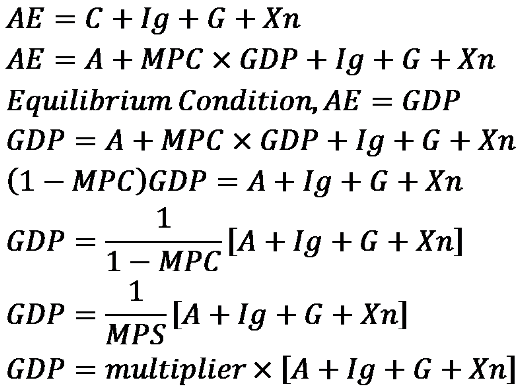
- Consequently, the multiplier = 1 / MPS
6. Equilibrium is stable
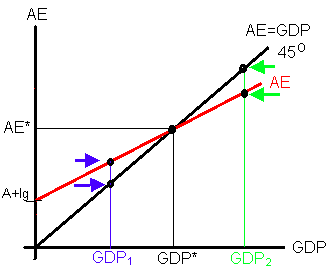
- At GDP 1, Aggregate Expenditures exceeds GDP
- Businesses and consumers are spending more than the amount of goods and services produced in the economy
- Inventories are falling
- Businesses increase their production of goods and services
- At GDP 2, GDP exceeds Aggregate Expenditures
- Businesses and consumers are spending less than the amount of businesses are producing
- Inventories are increasing
- Businesses decrease their production of goods and services
- When GDP = AE, economy is in equilibrium
- Total leakages = Total injections
- No unexpected changes in business inventories
|
Incorporaing Tourism into Aggregate Expenditures
|
|
1. Starting with the relationship, GDP = AE = C + Ig + G + Xn
- Tourism can lead to higher GDP
- Consumption - tourists buy goods and services
- Balance of Payments, Xn = Exports (X) - Imports (M)
- Tourists are invisible exports
- Tourist bring foreign currencies
- Tourist buy local goods and services
- Investment - private companies invest in tourist infrastructure
- Government Spending - improve infrastructure in a region
2. Problems of tourism
- Inflation
- Tourism creates higher demand for land, property, and goods / services
- International tourists will pay higher prices than domestic tourists
- Price increases are usually permanent
- Local population, especially ones not involved in tourism pay higher prices
- Opportunity costs
- If government invests in a tourist facility, program, or service, then the funding cannot be used for something else
- Use cost-benefits analysis to determine if efficient
-
Dependency
- reliance on a single industry
- A decrease in tourists can have negative impacts on a country, if country overrelied on tourists
- Use formula

- Example - Malaysia had approximately 22.4 million tourists in 2010
- 13.0 million tourists were from Singapore
- The dependency ratio is 58%
- Malaysia could have problems, if Malaysia falls out of favor from Singaporeans
- Tourist destinations are sensitive to changes in demand
- Wars, terrorism, and natural disasters scare tourists away
- Examples
- 2011 Riots in Egypt
- SARS outbreak in China
- Tsunami disaster in Thailand
- Economic development from tourism is unequal
- Tourist destinations developed economically
- Surrounding areas may not develop
- Seasonality
- A tourist destination may have one or two peak seasons
- Examples - Turkey, Greece, Eygpt, Spain, and Thailand
- High season - opportunity to earn large profits
- Low season - more difficult to earn profits
- Workers idle for part of the year
- Some facilities like hotels shut down for part of the year
- Difficult to recoup investment
- Leakages
- Tourist industry may import some goods and services for tourists
- Tourist industry may hire foreign workers
- Tax revenue flows out of tourist region
- Workers in tourist industry may be high savers
- Foreign owned hotels and businesses send their profits out of a country
|
The Multiplier Effect for Tourism
|
|
1. Multiplier Effect for Tourism
-
Direct effects
- tourism spend money on transportation, hotels, restaurants, etc
-
Indirect effects
- generated from economic activity of subsequent expenditure
- Hotels and restaurants purchase supplies and use local services
-
Induced effects
- arising from spending of income occurring to local residents from tourism wages and profits
- Investment activity: arising from capital investment in new facilities for visitors
- Government: public sector funding�
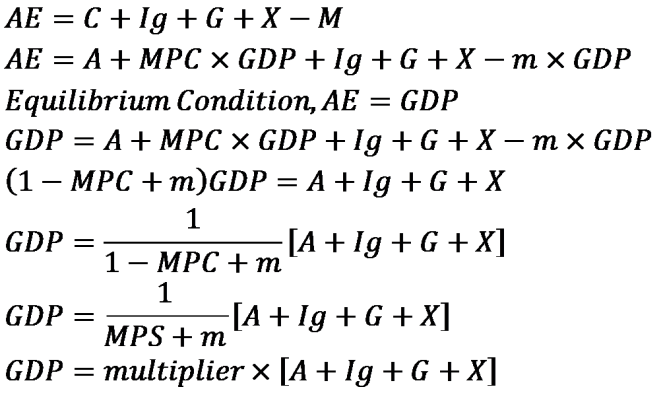
2. Derivation of the tourism multiplier
- Start with the equations,
- AE = C + G + Ig + X - M
- C = A + (MPC)(GDP)
- AE = GDP
- M = (m)(GDP)
- m is the portion of GDP that is imported
- Also called the marginal propensity to import
- Could be high for importing countries
- Assume - supply is elastic (or perfectly elastic); suppliers can meet the increase in demand
3. Income multipliers for several countries
- Small island countries have small multipliers
- Economy is small with high leakage
| Country |
Income Multiplier |
| Ireland |
1.776 - 1.906 |
| United Kingdom |
1.683 - 1.784 |
| Dominica |
1.195 |
| Bermuda |
1.099 |
| East Caribean |
1.073 |
| Bahamas |
0.782 |
| Cayman Islands |
0.650 |
Source: Horwath Tourism & Lesisure Consulting. November 1981. Tourism Multiplier Explained.
4. Different types of multipliers
-
Sales Multiplier
- the extra business turnover generated by an additional unit of tourist spending
-
Income Multiplier
- the extra income generated from an additional unit of tourist spending
- Could be defined as disposable income
- Could Include the increase in tax revenue
-
Employment Multiplier
- the extra employment created from an additional unit of tourist spending
| Country |
Sales Multiplier |
| Turkey |
2.339 - 3.198 |
| Barbados |
1.41 |
| Gwynedd, North Wales |
1.16 |
Source: Horwath Tourism & Lesisure Consulting. November 1981. Tourism Multiplier Explained.
|
Tools for Estimating Tourism Impact
|
|
1.
Input-Output Model
- represent interdependencies among industries in an economy
- Wassily Leontief
- Very simple
- Requires high quality data
- Cannot handle changes in relative prices
- Capital and labor are used in fixed ratios
- One worker for every machine
- Standard production function - ratio of capital and labor can be varied
- No excess surplus of production; all products and services are consumed
| |
Outputs |
| Input |
Agriculture |
Manufacturing |
Services |
Tourism |
Exports |
Total Outputs |
|
Agriculture
|
20 |
40 |
50 |
5 |
20 |
135
|
|
Manufacturing
|
60 |
20 |
10 |
10 |
10 |
110
|
|
Services
|
20 |
30 |
80 |
15 |
15 |
160
|
|
Tourism
|
0 |
0 |
20 |
5 |
15 |
40
|
|
Imports
|
35 |
20 |
0 |
5 |
0 |
60
|
|
Total Inputs
|
135
|
110
|
160
|
40
|
60
|
505
|
- Example
- Inputs to the tourism industry. Tourism uses 5 (billion) from agriculture, 10 (billion) from manufacturing, 15 (billion) from services, 5 (billion) from tourism industry, and 5 (billion) from imports.
- Total inputs = $40 (billion), which has to equal total outputs
- Notice, exports = imports
- Outputs to the tourism industry. Tourism has zero output to agriculture and manufacturing industries. However, services takes $20 (billion) in services, $5 (billion) in tourism, and $15 (billion) for exports.
- Imports for tourism is a leakage
- Total GDP should be the summation of all industries, $505 (billion)
- Tourism is 7.9% of economy
2.
Cost-Benefit Analysis
- Applies to new investment projects
- List all the costs and benefits of project
- Typical time span is 10 years or longer
- Problems
- Example - government has cost-benefits analysis to develop new beach
- Estimate tourists
- Private investment
- Jobs created, etc.
|
Terminology
|
- Keynesian multiplier effect
- direct effect
- indirect effect
- induced effect
- disposable income (DI)
- marginal propensity to consume (MPC)
- marginal propensity to save (MPS)
- aggregate expenditures (AE)
- autonomous spending (A)
- gross investment (Ig)
- net exports (Xn)
|
- government spending (G)
- lump sum taxes
- leakages
- injections
- dependency
- sales multiplier
- income multiplier
- employment multiplier
- input-output model
- cost-benefit analysis
|
|